Why Most Contractor Automation Fails (And the Question to Ask First)
Every week another agency tells a contractor the same thing: "You need more AI." A chatbot, a new CRM, an automated review machine. Six months later the software subscription is still billing and nobody has logged in since March.
The tool was not the problem. The order of operations was.
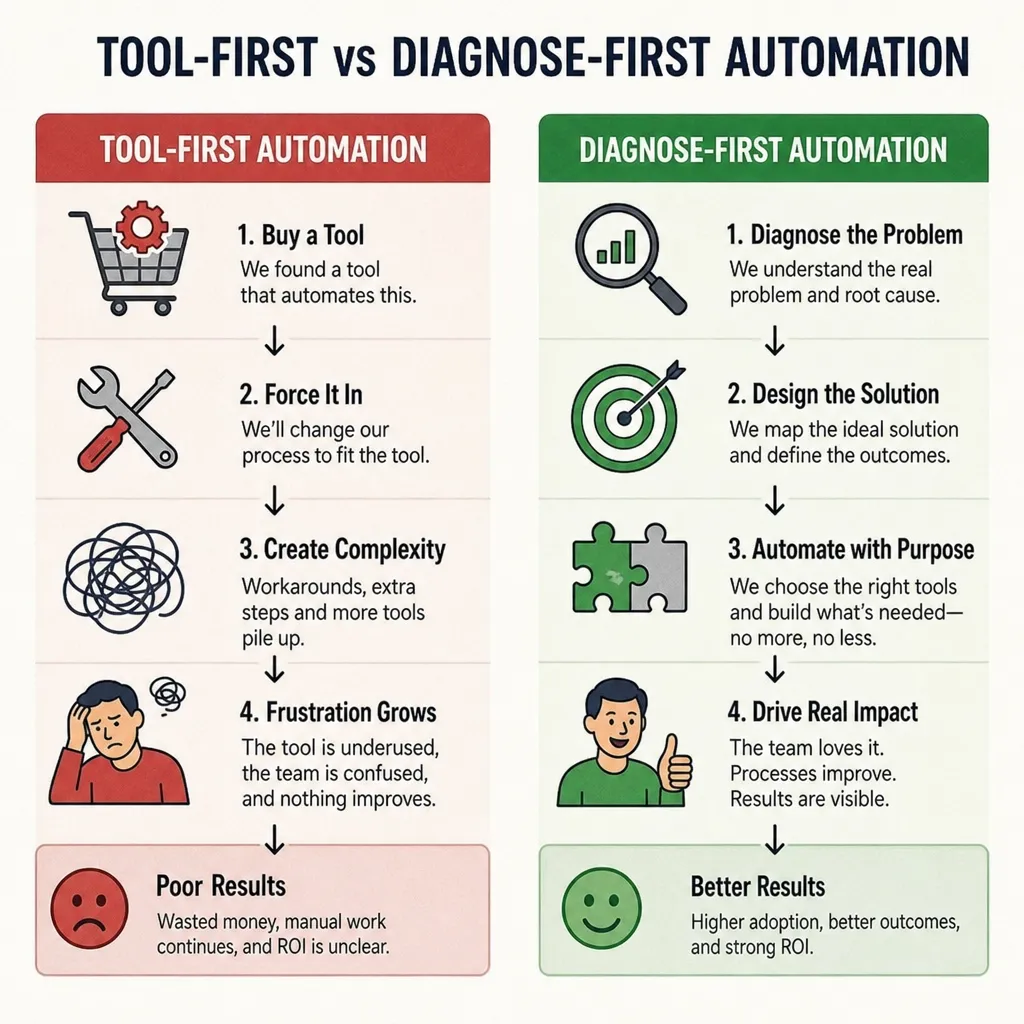
Tool-first is guessing with a budget
The conventional pitch starts with the product and works backward to your business. It has to, because the agency sells one thing. If all you sell is chatbots, every business problem looks like a missing chatbot.
The failure pattern is predictable:
- Software nobody asked for. The office manager already has a system that works in her head. The new tool adds a second place to check, so it becomes the place nobody checks.
- Automating the wrong step. Speeding up quote delivery does not help if the real constraint is that quotes wait a week for the owner's pricing review. You just deliver the delay faster.
- Shelfware. The subscription outlives the enthusiasm by about two years.
The question that should come first
Before any tool discussion, one question matters: where is the business actually stuck?
Not "what could be automated?" Almost everything could be. The question is which friction point is costing real money right now. In a home service company the usual suspects are:
- Speed to lead. Calls and texts that go unanswered while the caller dials your competitor. We've put a dollar figure on this one.
- Quote follow-up. Estimates that sit for two weeks with no touch, then quietly die.
- Paper shuffling. Job details re-typed from phone to whiteboard to invoice, with errors at every hop.
- Reactivation. Past customers who would book again if anyone ever contacted them.
- Visibility. No single view of what was quoted, booked, and collected, so every decision is a gut call.
Any one of these can be the biggest leak. Which one it is differs company to company, and the owner's guess is wrong more often than you would expect, because owners see the annoying problems, not necessarily the expensive ones.
What diagnose-first looks like in practice
A proper diagnosis is not a sales call with extra steps. It looks more like this:
- Pull the actual numbers. A month of call logs, a list of every open quote and its age, last year's customer list with last-service dates. The data usually contradicts at least one strongly held belief.
- Map the process out of the owner's head. Most contractor operations exist as tribal knowledge. Putting the whole flow on one wall, from first call to paid invoice, is often worth more than any automation that follows, because everyone finally sees the same picture.
- Price each leak. Missed calls at your average ticket. Dead quotes at your close rate. Every leak gets a dollar figure and a rank.
- Write the don't-touch list. The parts already working go on a list of things no tool is allowed to disturb. Sometimes the most valuable finding is what to leave alone.
Only after that does a tool conversation make sense, because now the tool has a job description and a payback number instead of a vibe. That diagnosis is exactly what our free operations assessment starts, and what a full audit finishes; the systems we build come after, not before.
The test for any agency (including us)
Ask the person pitching you: "What would you need to learn about my business before recommending anything?"
If the answer is a product demo, you have your answer. If the answer is a list of questions about your call volume, your quote pipeline, and your booking process, you are at least talking to someone who diagnoses before prescribing.
Your business is not a template. The automation that fits it will not come from one either.
What is tool-first automation, and why does it so often fail?
Tool-first starts with a product pitch and works backward to your business, so the solution is chosen before the problem is understood. Because agencies often sell one thing, every issue looks like a fit for that tool. The result is misalignment: software nobody asked for, automating the wrong step in the process, and subscriptions that turn into shelfware. The tool is not the problem. The order of operations is.
What kinds of leaks should a home service company look for first?
Focus on the friction that is costing real money now. Common leaks include speed to lead (missed or slow responses), quote follow-up (estimates going cold), paper shuffling (re-typing details with errors), reactivation (not contacting past customers), and visibility (no single view of quotes, bookings, and collections). Any one may be the biggest leak, and owners often guess wrong. Data usually reveals what is truly expensive, not just what is annoying.
How do I put a dollar figure on leaks to prioritize what to fix?
Translate each leak into lost revenue using your own metrics: missed calls multiplied by average ticket, dead quotes multiplied by your close rate. Rank leaks by dollars lost. This turns nice-to-have ideas into business cases and prevents buying shiny tools that do not move the numbers.
How can I tell if an agency diagnoses before prescribing?
Ask: "What would you need to learn about my business before recommending anything?" If the answer is a product demo, that is tool-first. If they ask about your call volume, quote pipeline, and booking process, they are diagnosing. As a quick start, the free 3-minute Operations Assessment scores your operation across the five leak points and shows which one is costing you most.